MSc Dissertation
How adolescent reading habits have changed worldwide, and what they relate to cognitively, using PISA data from 2000 to 2022.
Overview
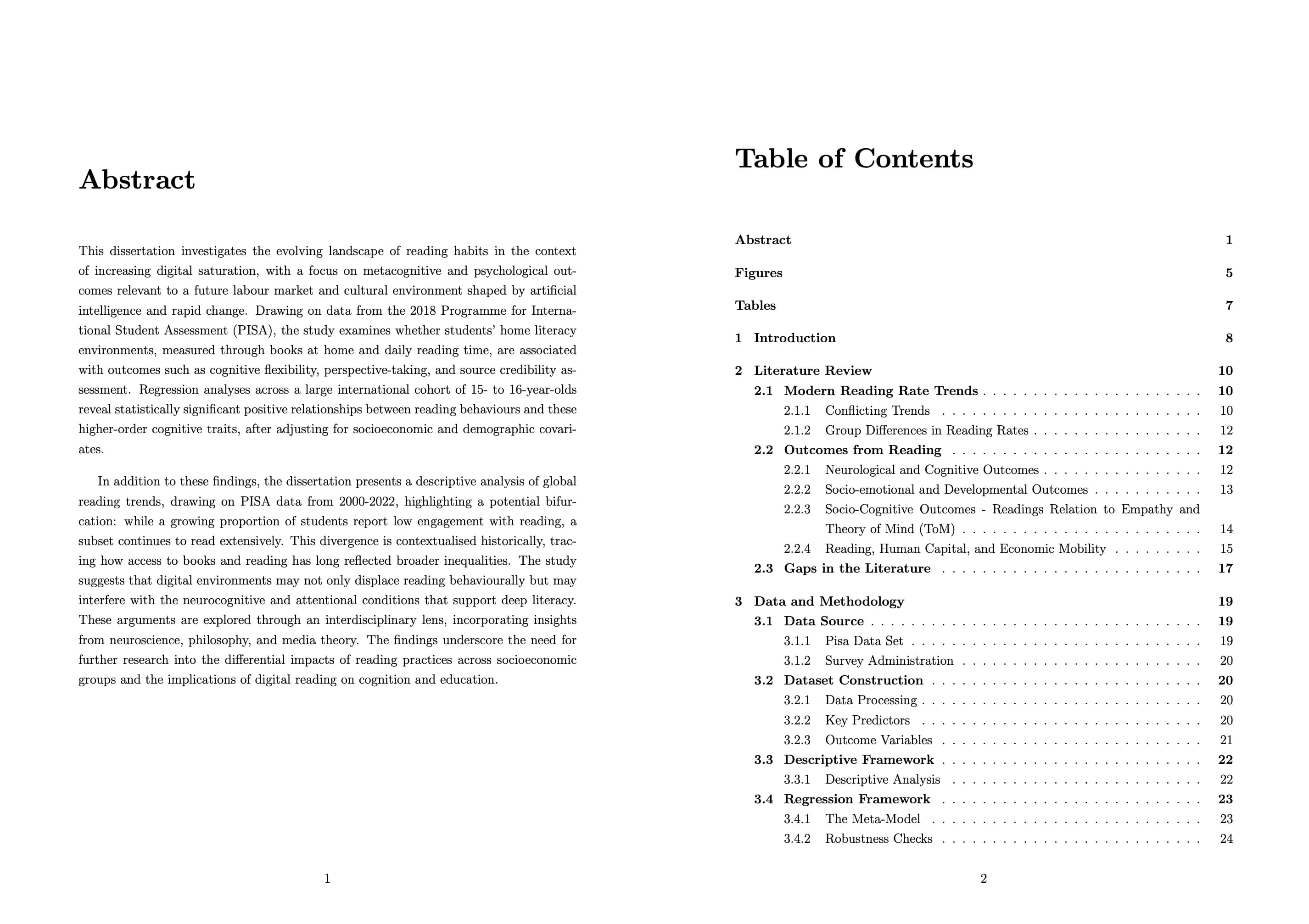
This dissertation idea emerged from a long-standing interest in reading, both as a personal habit and as a cognitive activity. Using large-scale PISA datasets spanning more than two decades, the project examines global trends in adolescent reading behaviour, how those trends differ across socio-economic contexts, and what reading engagement might be associated with in terms of cognitive and metacognitive outcomes.
Working with data at this scale meant balancing ambition with restraint, asking questions that could produce meaningful answers while staying honest about what observational data can and cannot show.
Overview
Why It Matters
I enjoy reading, yet persistent claims suggest that reading is in decline, particularly among younger cohorts. At the same time, the benefits of reading are often asserted loosely, without much clarity about what those benefits actually are or how far they extend.
The dissertation set out to examine those claims carefully. I wanted to know whether reading is meaningfully associated with how people understand, monitor, and regulate their own thinking, instead of simply assuming it is good for us. That question led naturally into the neuroscience and psychology of reading, especially work on metacognition, comprehension, and cognitive engagement.
Large-scale datasets like PISA force difficult methodological questions such as what actually counts as reading, which cognitive outcomes are measurable at scale, and how much interpretation is justified when working with proxies rather than direct measures.
Methods
Data & Methods
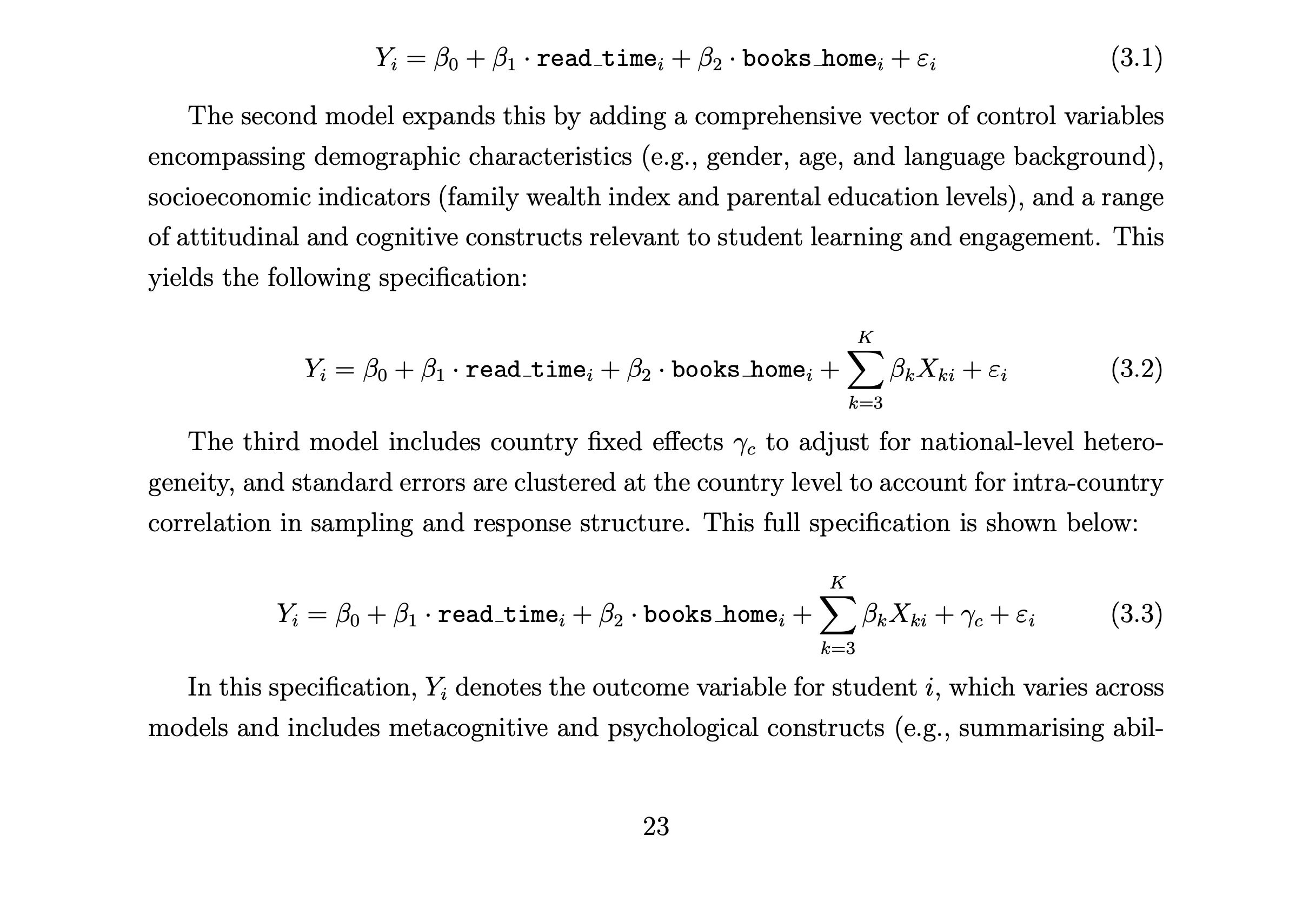
The analysis draws on repeated cross-sectional PISA data from over 80 countries, combining behavioural indicators, socio-economic measures, and cognitive and metacognitive variables. Working with such a broad dataset required careful preprocessing, extensive validation, and constant cross-checking against the underlying survey design.
Much of the challenge was turning theoretical concepts from psychology and neuroscience into variables that could actually be measured, which took repeated iteration and close engagement with the literature.
Graphs
Key Findings
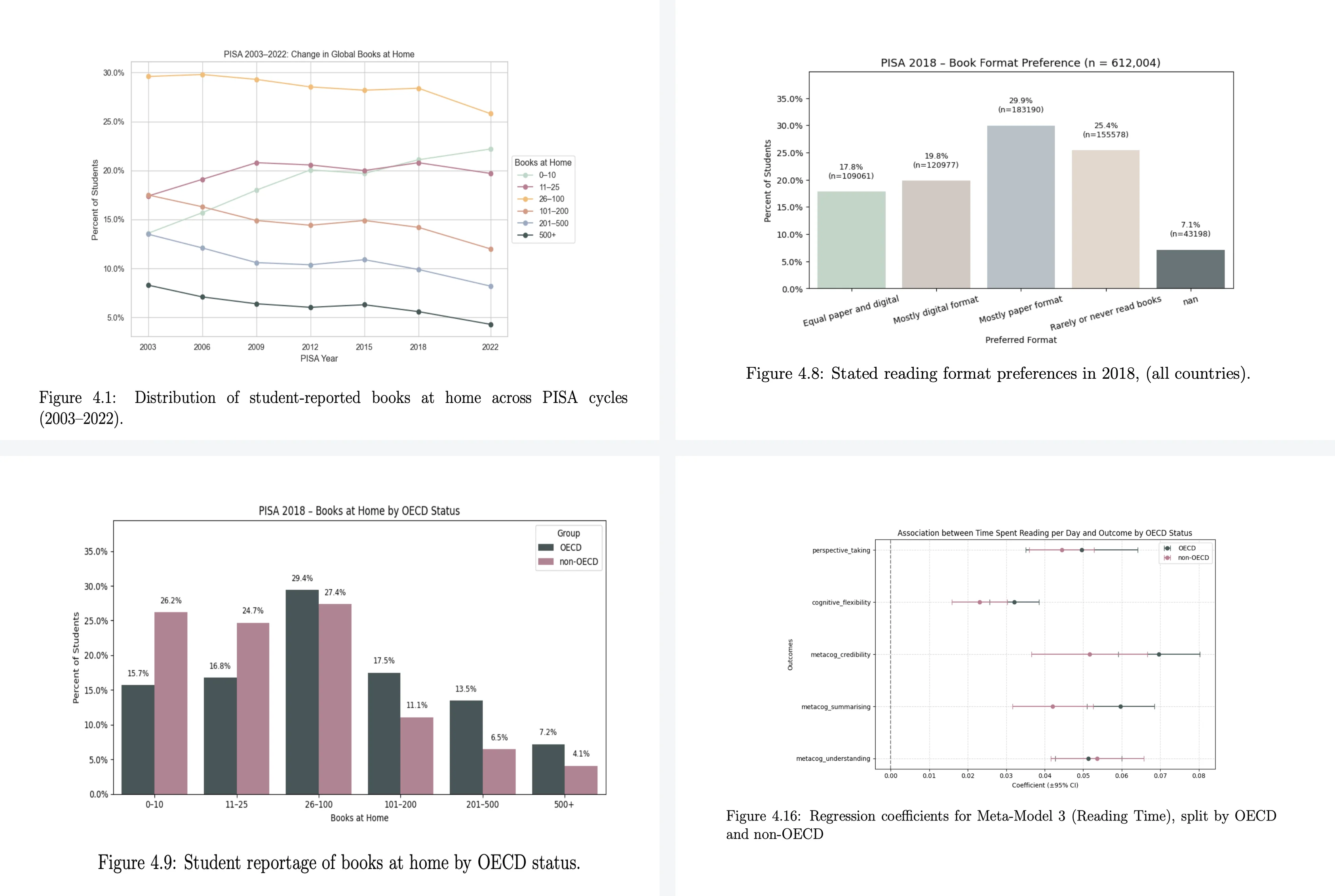
The results point to a sustained global decline in voluntary reading, with increasingly pronounced differences along socio-economic lines. Adolescents from more advantaged backgrounds tend to maintain higher levels of reading engagement, while participation declines more sharply elsewhere.
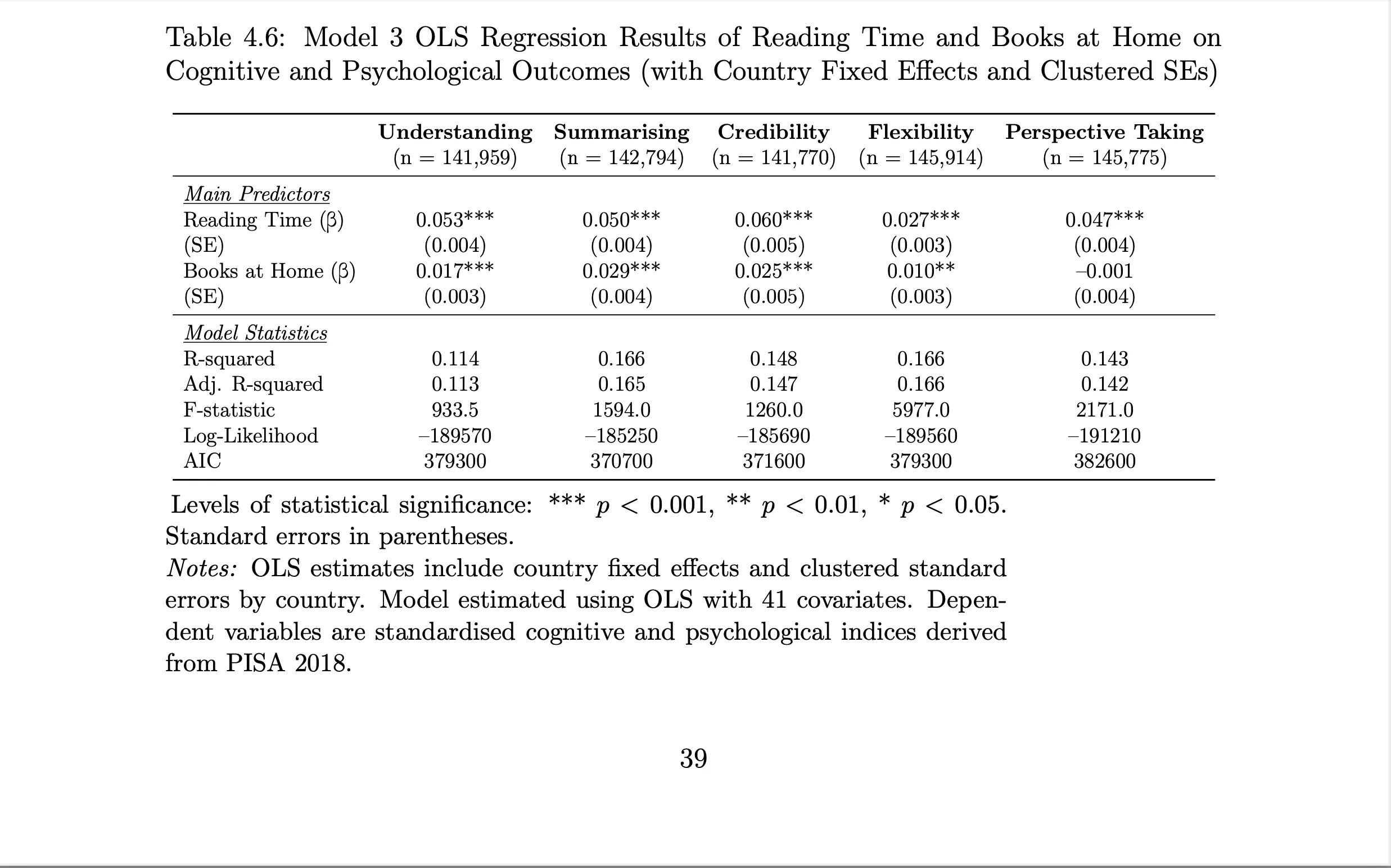
Reading engagement is positively associated with metacognitive outcomes, such as self-monitoring, empathy and reflective strategies. These effects are small in magnitude but statistically reliable across cohorts and regions, suggesting that reading may play a meaningful role in cognitive development.
Code
Challenges
Identifying the right data was only the first step; cleaning, restructuring, and validating it proved far more time-consuming than anticipated. Building custom indices for cognitive and metacognitive outcomes was the most difficult component, requiring sustained engagement with the neuroscience and psychology literature to ensure conceptual coherence.
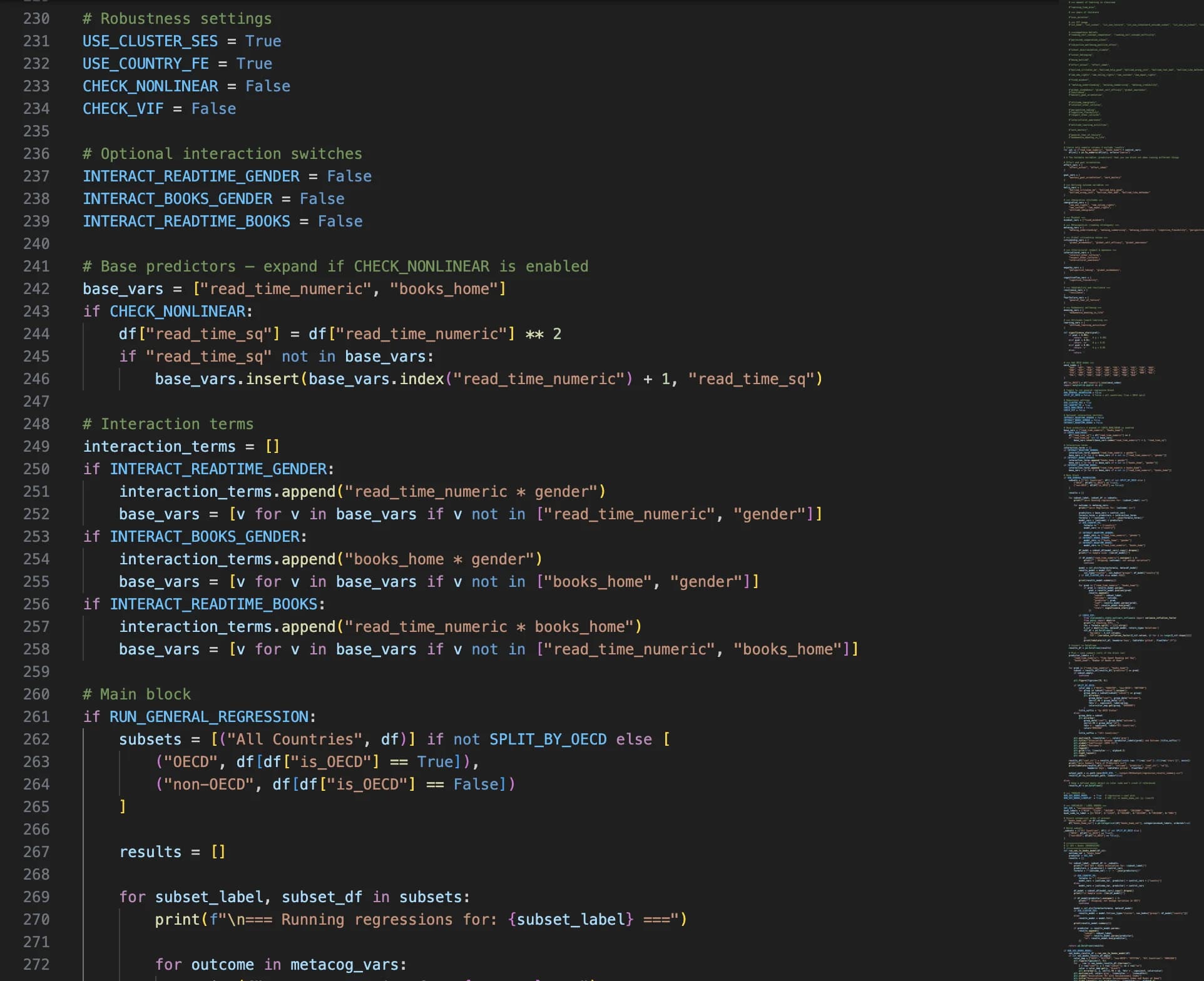
In total, the analysis relied on roughly twenty modular Python scripts, each designed for specific stages of loading, cleaning, transforming, and analysing the data. Much of the work involved debugging edge cases, revisiting assumptions, and learning when a model was answering the wrong question, even if it appeared statistically sound.
Results
Learning
The project clarified how much care is required when working with large observational datasets. Small modelling choices, variable definitions, and assumptions about what survey items represent can materially change the story a model appears to tell, even when results look statistically robust.
The main value of the work was therefore methodological, as it involved learning how to test ideas cautiously, document decisions clearly, and recognise when a model answers a different question than the one originally posed.
Built with
- Excel
- Python
- Overleaf
More projects